Consequences of lethal-whole-body gamma radiation and possible ameliorative role of melatonin
Abstract
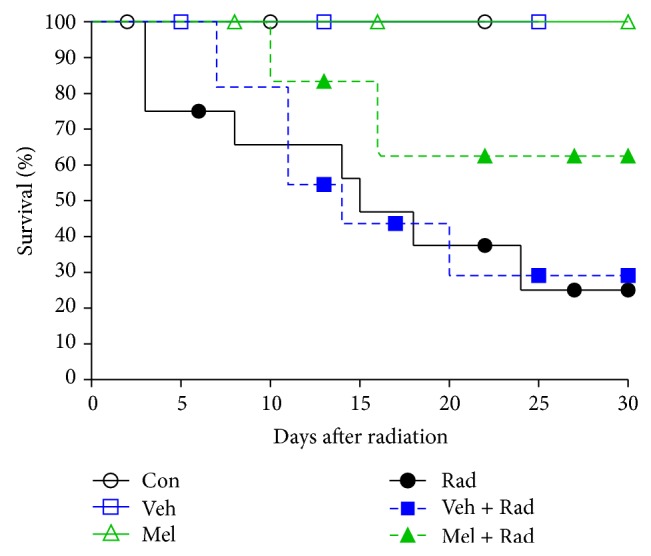
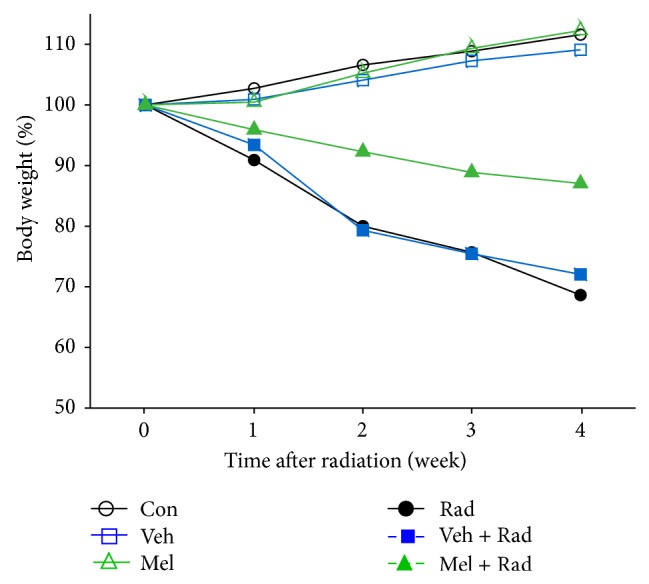
Gamma radiation induces the generation of free radicals, leading to serious cellular damages in biological systems. Radioprotectors act as prophylactic agents that are administered to shield normal cells and tissues from the deleterious effects of radiation. Melatonin synergistically acts as an immune-stimulator and antioxidant. We investigated the possible radioprotective role of melatonin (100 mg/kg i.p.) against lethal-whole-body radiation- (10 Gy) induced sickness, body weight loss, and mortality in rats. Results of the present study suggest that exposure to lethal-whole-body radiation incurred mortality, body weight loss, and apoptosis and it also depleted the immunity and the antioxidant status of the rats. Our results show that melatonin pretreatment provides protection against radiation induced mortality, oxidative stress, and immune-suppression. The melatonin pretreated irradiated rats showed less change in body weight as compared to radiation only group. On the other hand, melatonin appeared to have another radioprotective role, suggesting that melatonin may reduce apoptosis through a caspase-3-mediated pathway by blocking caspase-3 activity.
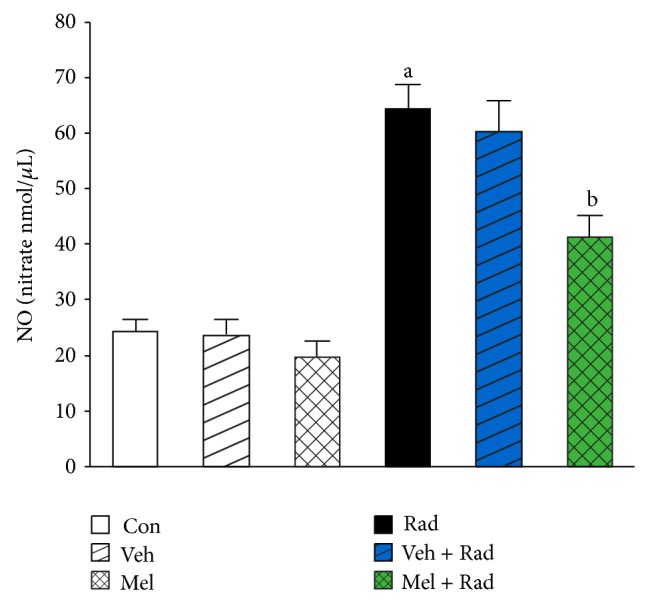
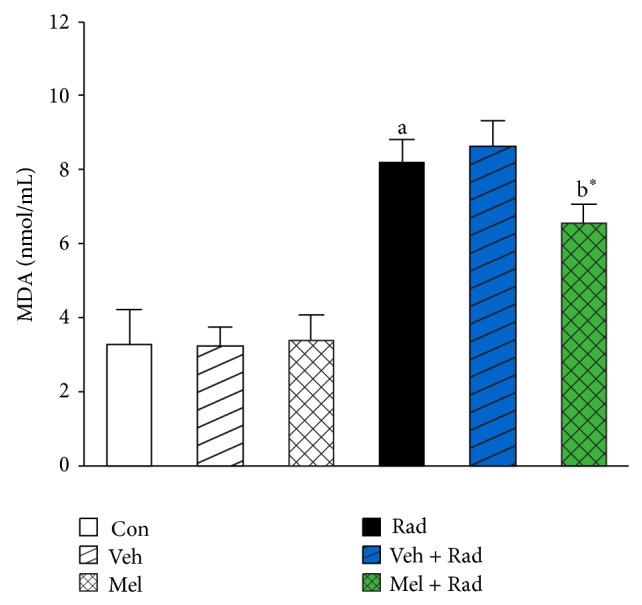
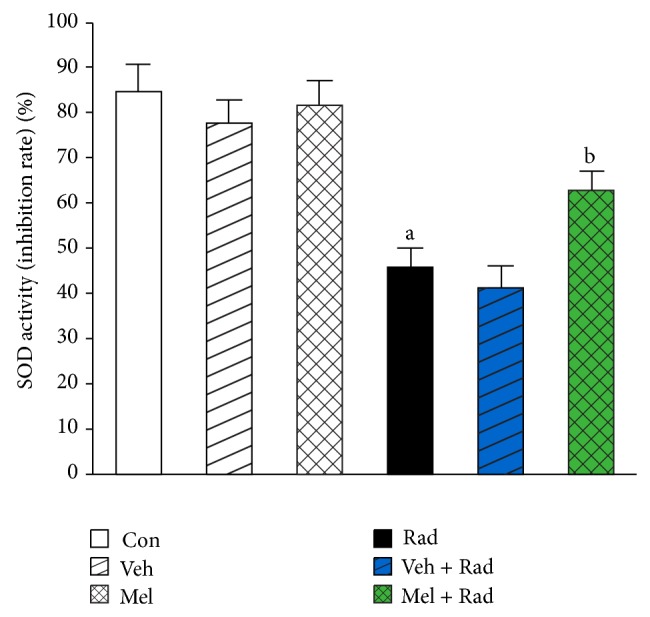
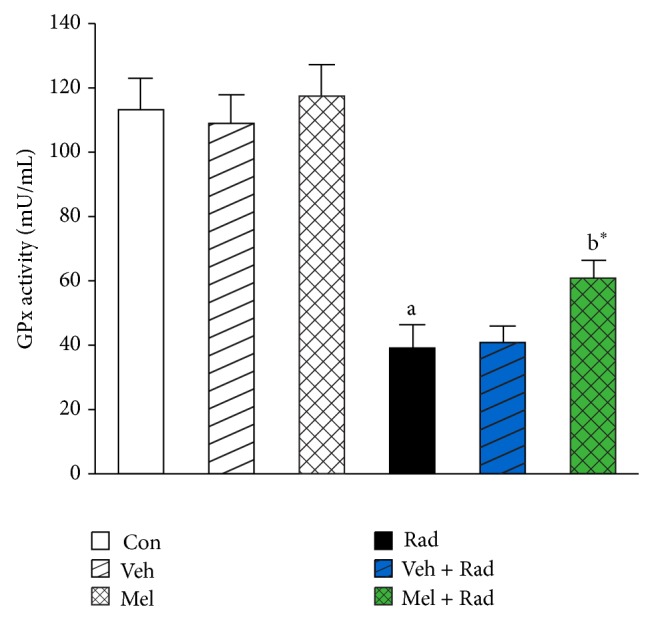
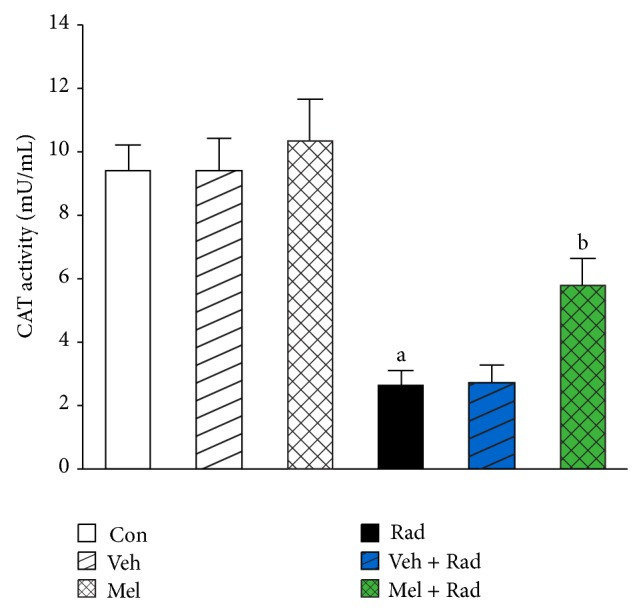
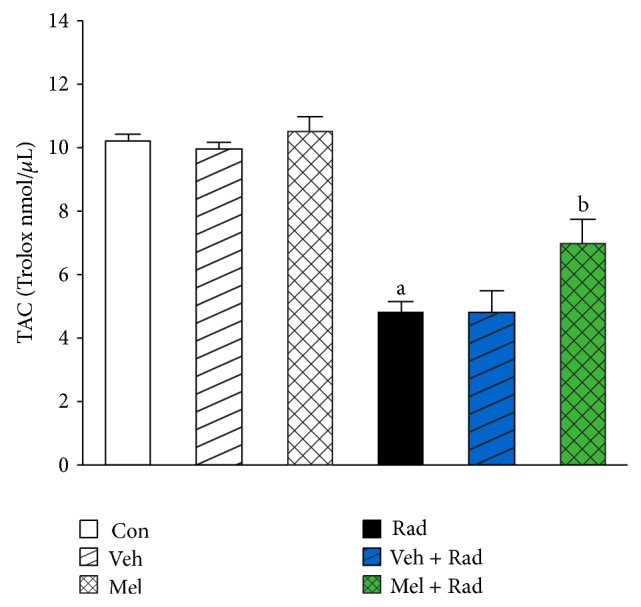
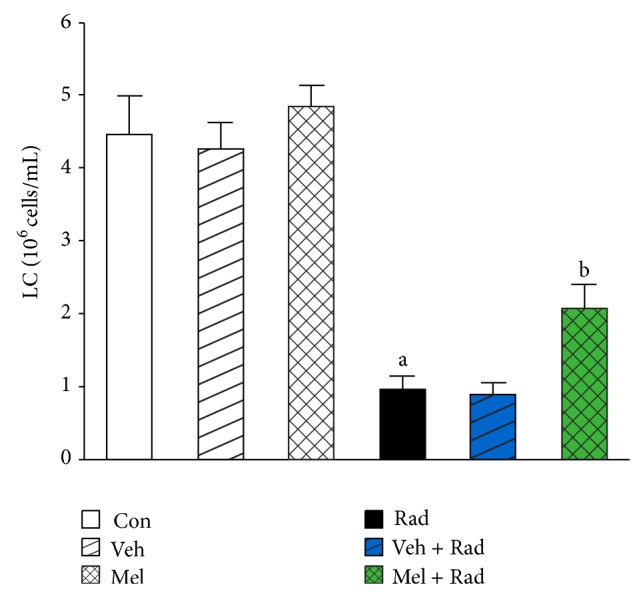
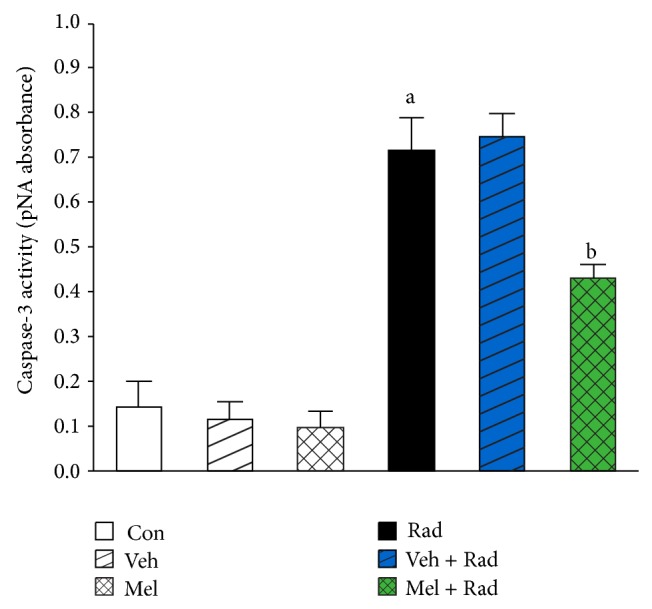
Figure 1 Survival of whole body irradiated rats pretreated with melatonin. Con: Control group, Veh: Vehicle only group, Mel: Melatonin only group, Rad: Radiation only group, Veh + Rad: Treated with vehicle and exposed to 10 Gy radiation, and Mel + Rad: Treated with 100 mg/kg melatonin before exposure to 10 Gy radiation.Figure 2 Percent change in body weight of rats. Con: Control group, Veh: Vehicle only group, Mel: Melatonin only group, Rad: Radiation only group, Veh + Rad: Treated with vehicle and exposed to 10 Gy radiation, and Mel + Rad: Treated with 100 mg/kg melatonin before exposure to 10 Gy radiation.Figure 3 The effect of melatonin on NO levels in rats subjected to whole body gamma irradiation. Data represent mean ± standard error on the mean (SEM) for 5 animals per group. Con: Control group, Veh: Vehicle only group, Mel: Melatonin only group, Rad: Radiation only group, Veh + Rad: Treated with vehicle and exposed to 10 Gy radiation, and Mel + Rad: Treated with 100 mg/kg melatonin before exposure to 10 Gy radiation. aP < 0.001 when compared to Control group. bP < 0.001 when compared to the radiation only group.Figure 4 The effect of melatonin on MDA levels in rats subjected to whole body gamma irradiation. Data represent mean ± standard error on the mean (SEM) for 5 animals per group. Con: Control group, Veh: Vehicle only group, Mel: Melatonin only group, Rad: Radiation only group, Veh + Rad: Treated with vehicle and exposed to 10 Gy radiation, and Mel + Rad: Treated with 100 mg/kg melatonin before exposure to 10 Gy radiation. aP < 0.001 when compared to Control group. b*P < 0.01 when compared to the radiation only group.Figure 5 The effect of melatonin on SOD activity in rats subjected to whole body gamma irradiation. Data represent mean ± standard error on the mean (SEM) for 5 animals per group. Con: Control group, Veh: Vehicle only group, Mel: Melatonin only group, Rad: Radiation only group, Veh + Rad: Treated with vehicle and exposed to 10 Gy radiation, and Mel + Rad: Treated with 100 mg/kg melatonin before exposure to 10 Gy radiation. aP < 0.001 when compared to Control group. bP < 0.001 when compared to the radiation only group.Figure 6 The effect of melatonin on GPx activity in rats subjected to whole body gamma irradiation. Data represent mean ± standard error on the mean (SEM) for 5 animals per group. Con: Control group, Veh: Vehicle only group, Mel: Melatonin only group, Rad: Radiation only group, Veh + Rad: Treated with vehicle and exposed to 10 Gy radiation, and Mel + Rad: Treated with 100 mg/kg melatonin before exposure to 10 Gy radiation. aP < 0.001 when compared to Control group. b*P < 0.01 when compared to the Radiation only group.Figure 7 The effect of melatonin on CAT activity in rats subjected to whole body gamma irradiation. Data represent mean ± standard error on the mean (SEM) for 5 animals per group. Con: Control group, Veh: Vehicle only group, Mel: Melatonin only group, Rad: Radiation only group, Veh + Rad: Treated with vehicle and exposed to 10 Gy radiation, and Mel + Rad: Treated with 100 mg/kg melatonin before exposure to 10 Gy radiation. aP < 0.001 when compared to Control group. bP < 0.001 when compared to the Radiation only group.Figure 8 The effect of melatonin on TAC levels in rats subjected to whole body gamma irradiation. Data represent mean ± standard error on the mean (SEM) for 5 animals per group. Con: Control group, Veh: Vehicle only group, Mel: Melatonin only group, Rad: Radiation only group, Veh + Rad: Treated with vehicle and exposed to 10 Gy radiation, and Mel + Rad: Treated with 100 mg/kg melatonin before exposure to 10 Gy radiation. aP < 0.001 when compared to Control group. bP < 0.001 when compared to the Radiation only group.Figure 9 The effect of melatonin on LC in rats subjected to whole body gamma irradiation. Data represent mean ± standard error on the mean (SEM) for 5 animals per group. Con: Control group, Veh: Vehicle only group, Mel: Melatonin only group, Rad: Radiation only group, Veh + Rad: Treated with vehicle and exposed to 10 Gy radiation, and Mel + Rad: Treated with 100 mg/kg melatonin before exposure to 10 Gy radiation. aP < 0.001 when compared to Control group. bP < 0.001 when compared to the Radiation only group.Figure 10 The effect of melatonin on caspase-3 activity in rats subjected to whole body gamma irradiation. Data represent mean ± standard error on the mean (SEM) for 5 animals per group. Con: Control group, Veh: Vehicle only group, Mel: Melatonin only group, Rad: Radiation only group, Veh + Rad: Treated with vehicle and exposed to 10 Gy radiation, and Mel + Rad: Treated with 100 mg/kg melatonin before exposure to 10 Gy radiation. aP < 0.001 when compared to Control group. bP < 0.001 when compared to the Radiation only group.